Devina Kothari
Design Innovations
8. Knob / Flame regulating Valve:
Flame-regulating knob made up of Teflon or high performance plastic. The graphical representation on the surface indicates the high, medium and low flame regulation through a non-return valve. A filter is fitted at the end of the valve to prevent debris from entering into the siphon and affecting the efficiency of the stove.

9. Pot Support:
Galvanised Mild steel five-legged support. The shape is such that the sole has maximum base area at the same time the ellipsoid void saves material and hence the cost. The protruding lips provide five-point support to the grate.


10. Socket Casing:
Blue pigmented ABS (Acrylonitrile Butadiene Styrene) or Nylon casing for the output (2 pin) for the external device (LED, radio, mobile phone, etc). It transmits the electrical energy generated from all the batteries to a common output.
Various batteries store the electrical energy generated from the thermopile.
12. Storage Batteries:
These batteries store electrical energy generated from the thermopile, that can be used later even when the stove is not in use. The batteries need to be re-charged periodically by using the stove.

11. Plug:
External illuminating source is plugged into the socket for electrical supply.
14. Connectors:
These batteries store electrical energy generated from the thermopile, that can be used later even when the stove is not in use. The batteries need to be re-charged periodically by using the stove.

13. Battery Casing:
Grey pigmented ABS (Acrylonitrile Butadiene Styrene) or Nylon casing with high reflective
surface, which provides a casing/house for the batteries and wiring. This casing is covered by the lining of the combustion chamber, which also acts as insulation.
15. Outer Casing:
PTFE (Polytetrafluroethylene) coated sulphuric acid anodized aluminum perforated sheet. This further insulates the outer body from the internal heat, thereby making it safe to touch. It also provides extra ventilation, which will help to ventilate the thermopile and the heat dissipated from the combustion chamber. PTFE coating protects the surface from grease and aids in keeping the surface clean. Added cleanliness helps to keep the insects away and provides a healthier environment and food for the poor.


16. Intermediate Plate:
The sulphuric acid anodized aluminum plate is threaded along one edge, which attaches it to the storage compartment. The opposite end is locked to the outer casing/body, thereby serving as a partition between the chambers.

17. Storage Compartment:
Sulphuric acid anodized aluminum perforated sheet compartment, which stores the cleaning tools like cleaning needle, spanner, nylon bristle brush, wire brush, etc.
18. Nylon Legs:
The nylon legs lift the stove and the fuel tank above the ground level thereby protecting it from abrasion, corrosion, insects and water. It also helps to maintain a balance, as the stove would be used on the ground, which may or may not be leveled and finished.
19. Fuel tank:
Double walled stainless steel fuel tank for storage of 55-60% concentrated ethanol. The outer surface is painted yellow to demarcate it from the conventional LPG, kerosene, diesel and petrol fuel tanks. The paint is applied with respect to the C3, medium category corrosion with two-pack epoxy or polyurethane primer suitable for stainless steel at 30-50 micron dry, followed by polyurethane finish at 100 micron dry. The tank can be made available in multiples of 5 litres (5L, 10L, 15L, etc). Smaller volume helps poor people to get refill without high investment (pre-payment) at the same time, women for long distances can easily carry it.

20. Pressure and Fuel Indicator
The fuel tank is pressurized to 2-3 atm with the help of the locally available hand operated cycle pump. The adequate pressure is attained as soon as the needle points to the green area. When the needle points to the red area, it indicates loss of pressure due to leakage or inadequate pressure thereby requiring attention. Another needle is used to indicate the fuel content in the tank. Apart from the pressure indicator for visual clue to leakage, the odor of additives (similar to mercaptan) presents an olfactory clue to the leakage, raising an alarm.

21. Air valve:
A non-return brass valve to ensure pressurizing of the contents in the fuel tank.
22. Handle
23. Simmer plate:
The simmer plate is used to make 'Chapatis' or roast bread. It fits into the stove, to avoid burns due to accidental touching.

Operating the Stove: Micro-Activity

Twist the yellow knob/flame regulating valve.
Ignite the flame and adjust the flow of fuel.
Place the pot onto the stove and begin cooking.
To switch on the LED, push the plug into the socket and switch it on.
In case of fuel refilling (fuel content is indicated along with pressure indicator on the fuel tank), twist the fuel check valve and disconnect it from the stove. The tank can be refilled at the nearest government booth or a local micro-distillery, upon verification of the "Aadhaar card".
The tank is attached to the stove and the pressure is raised to 2-3 atmospheres by using a hand operated cycle pump. Upon reaching an optimum pressure, the needle on the pressure indicator points to 'green'.
Twist the yellow knob/flame regulating valve.
1
2
4
5
6
3
7

6. Grate:
Mild steel grate rests onto the five-legged support. It is connected to the fuel siphon and the carbon steel flame jet.
7. Rubber Tube:
The inner surface is made up of synthetic rubber resistant to ethanol and re-enforced with brass coated steel wire and outer coating of synthetic rubber resistant to abrasion, weather, fire and ethanol.
Proposed to: Toyotomi, Japan.
Concept Name: Urja
Description:
"URJA", in Sanskrit language means 'Energy'.The design of the cook stove is based on the idea of it being the source of energy, which provides heat & light to all, irrespective of the geographical, socio-cultural or economic backgrounds.
The design of the cook stove targets the needs of the citizens living in the rural areas of developing countries, where availability of common combustion fuel like kerosene, LPG is very difficult and increasingly expensive due to inflation.
It proposes simultaneous production of food and fuel. Combustion of this fuel, helps to generate alternative energy to be used to increase their income from cottage industries and helps them to attend night schools.
1 Cook Stove

Heat Energy

Developed Economies
Transition Economies
Less Developed Economies
Least Developed Economies
Data not available

Map 1
Map 2
Sugarcane growing areas
If we overlap the maps 1 and 2, we decipher that the Developing countries are major sugarcane growing areas in the world.
This led to the idea of generating Bio-fuel as a by-product of the agricultural produce.
The Concept:
To convert the untapped excessive heat energy produced during cooking and boiling of water into electrical energy, using the ‘Seebeck Effect’ and
Thermophiles.
The idea is to cultivate combustion fuel along with the edible agricultural produce, so that the fertile land is not exclusively utilized to generate biofuels (if so, the price of the fuel might reduce, but the price of the edible items might increase, thereby leading to similar crisis with further disadvantages).
Drawbacks of the existing combustion fuel:
Existing combustion fuel: Kerosene
Disadvantages:
-
Excessive smoke and soot around the user, causing severe health threats on prolonged usage.
-
Periodic increase in the selling price of kerosene and speedy depletion of fossil fuels.
Due to the above mentioned primary drawbacks, there is a need to generate an alternative solution, which can be easily adopted into the daily lifestyle of the users.
The heat energy produced while cooking and boiling water is dissipated into the surrounding environment in the existing design of stoves.
Overview:
The proposed design converts this untapped heat energy (which otherwise is not useful) and converts it into electricity with the help of easily available TEG (thermo-electric generators) and Seebeck effect. This would aid the users to generate their own electricity to light up their houses using LEDs, which are more efficient than the conventional bulbs or CFLs (compact fluorescent lamps). With this improvisation the user and their families would be able to read, study or work even after dusk, thereby increasing their efficiency, daily income and help them to benefit from the government night school programs.
Proposed Combustion fuel: Ethanol (biofuel)
The design projects a greener future and hints towards an industrious growth potential.
Impact on User's life:
-
The users shall be able to generate their own electricity, which shall be more efficient than the government electricity grid system for the rural areas, as it eliminates the heavy losses in transmission (efficiency of electric power plants are rated at 30%, and the losses due to transmission and distribution amount to further 20%, resulting in the overall efficiency of the electric power at the household socket to 24%).
-
The user shall not be dependent on the government or the international market for fuel.
-
The user can generate his own safe drinking water, which shall give him and his family a healthy future.
-
The user can cook his food, using his/her own fuel priced as low as Rs. 15/litre, which cooks food for a family of five for 2 days and boils water for 40 min. This shall help him save more money, which can be better utilized for education.
-
The electricity generated from the heat, can be used to power an LED in the evening, which shall add at least three hours per person per day of work and add to personal efficiency. The illumination can aid the family to work in shifts to prosper cottage industries, handicrafts, protect them poisonous reptiles, and help the children to study in the night, while the day is occupied in earning livelihood.
These combined benefits aim to brighten the future of the rural areas and generate a better standard of living for them instead of luring them to migrate to larger cities for livelihood and better standard of living. This shall help the larger cities from getting over populated and aid in distributing the resources proportionately across
the country.
The user shall benefit from a cleaner living environment than the existing kerosene wick based cook stove or hurricane lamps, with lesser soot formation, smoke and sound emission.
Electrical Energy

Sugarcane
Ethanol


Light from LED
Heat from Stove


Working Principle


Conventional Light source vs LED light source

Manufacture of Ethanol from sugar-rich biomass:

Bio-Mass
Slurry
Tank
Jet-Cooking

Sugar Beet
and
Sugarcane
Evaporation

Fuel Tank/cylinders:
Use of pressurized cylinder, overcomes the drawback of frequent pumping (frequent pumping results in shaking of the stove and thus breaking the fragile mantle and over pressurizing the storage tank often results in explosions and fires). After filling-refilling the cylinder with ethanol, a pressure of 2-3 atmospheres is achieved using a common hand operated cycle pump (locally available to fill air in the tire tubes).
Cook Stove:
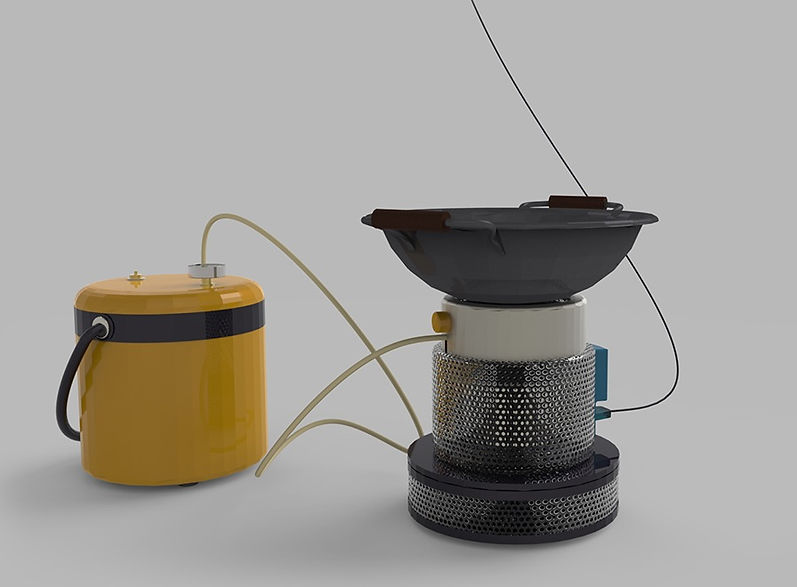
The cook stove assembly mainly comprises of the stove, cylinder and the LEDs. The stove is in turn an
assembly of mainly the pot support, combustion
chamber, storage compartment, and the outer envelope
(which shall be discussed in detail in forthcoming
pages).
LED:
LED light source consuming less than 20W but producing illumination equivalent to that of 100W
incandescent bulb. Lesser versions of LED may also be used, depending upon the need and economics.
Air Valve
Rubber Tube
Knob / Flame
Regulation Valve
Large Cookware
Lining of the Combustion Chamber
Casing for
the Socket
Plug
Intermediate Plate
Storage Compartment
Fuel Tank

Exploded View
Lining of the Combustion
Chamber
Thermopile Component
Flame Deflector
Flame jet-Fuel Siphone-Grate
1
2
3
4-5-6
7
Knob/Flame Regulating Valve
8
Rubber Tube
Pot Support
9
Socket Casing
10
Plug
12
Connectors
14
13
Battery Casing
15
Outer Body / Casing
Functional + Material and Surface Finishes

1. Lining of the combustion chamber:
5/18 thick galvanized mild steel sheet combustion chamber with a coating of type E fiber glass gel onto the inner non-exposed surface (coating to be done prior to the bending process). This reduces the heat transfer onto the outer surface making it safer during an accidental touch. It also acts as a windshield.
2. Thermopile Component:
The saucer shaped 6mm thick Bismuth charcogenide thermopile (TEG) is coated with a thin layer of graphite. The saucer shape rests well onto the five-legged pot support. The inner parapet resists spillage (if any) onto the flame deflector, thereby protecting it from clogging and reducing the frequency of cleaning. It also acts as a windshield.

4. Flame Jet:
Carbon steel flame jet with a non-return valve.
5. Fuel Siphon:
Carbon steel fuel siphon.

3. Flame deflector / Flame spreader:
Mild steel flame deflector that rests onto the mild steel grate and siphon assembly.

Sweet Corn
Sorghum
Separation
Liquification
Distillation
Cook Stove
Ethanol
Drying
Other Biofuels
Animal Fodder
Fermentation
Pre-treatment/ Hydrolysis

Nylon Legs
18
Renewable Energy
Design Direction
Mechanical Treatment
Chemical Treatment
Biological Treatment
Thermal
Treatment
End Product
Parts and Components
Storage Batteries
11
16
Intermediate Plate
Storage Compartment
17